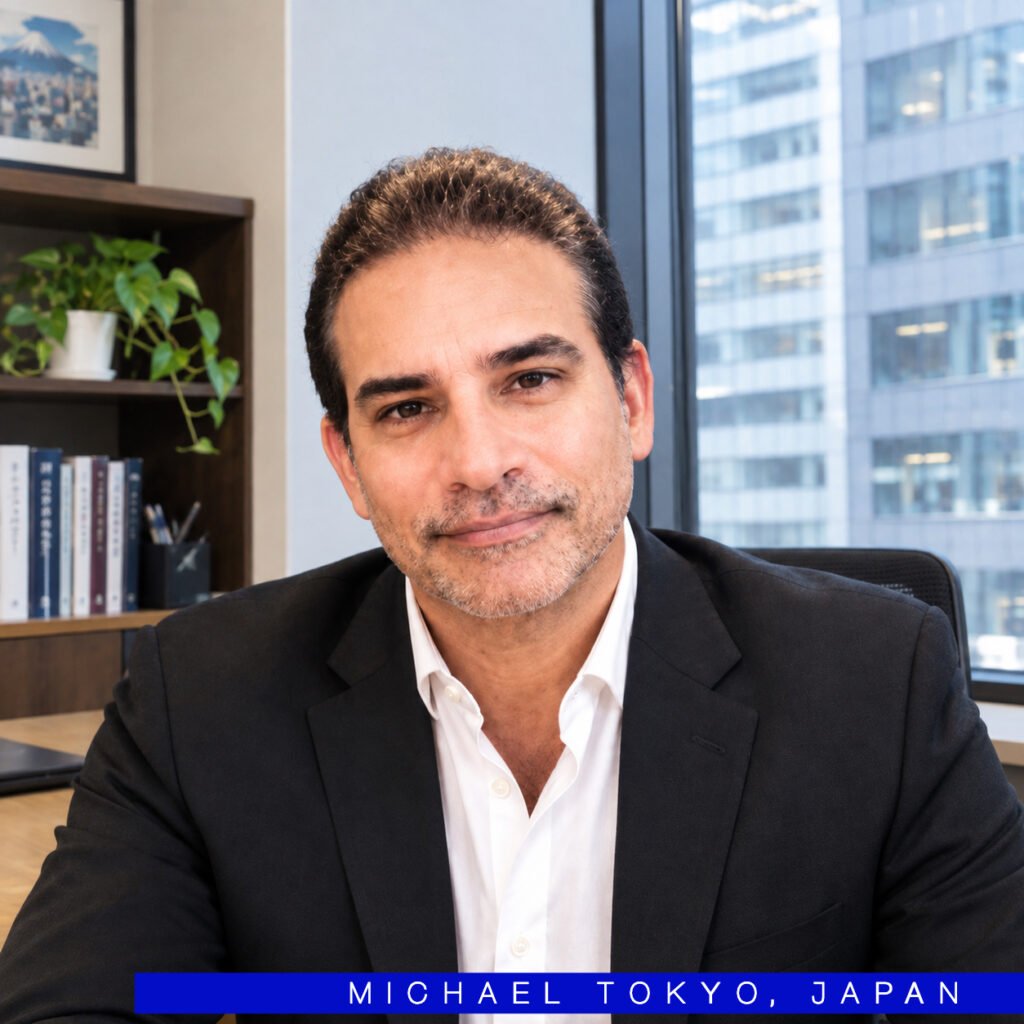
Michael Machida CEO TheJEGroup! Japan
The Decision to Leave America
Michael Machida CEO TheJEGroup! Japan ~ More than 27 years ago, I left America and moved to Japan, however not forever. At the time, I didn’t know that decision would shape almost every part of my professional and personal life.
I didn’t know I’d spend decades working with people from different countries, assisting them to find jobs, prepare for interviews, move overseas and, in some cases, start businesses of their own. I certainly didn’t imagine that one day I’d look back and realize I’d helped more than 4,500 global job hunters.

“I just knew I wanted to experience something different…”
Moving to another country sounds exciting when you’re looking at it from the outside. And it is. But excitement only gets you so far. Once you actually live somewhere, the romantic idea of being an expatriate meets the ordinary demands of everyday life. You have to work. You have to pay your bills. You have to figure out how things work.
You have to make friends, build relationships and learn how to communicate with people who may have very different assumptions about business and life. Japan taught me all of that. It also taught me patience.

Learning to Live Somewhere New
When I arrived, I had to learn a culture that was familiar in some ways and completely foreign in others. I had to understand how Japanese companies operated, how professional relationships were built and how communication could sometimes depend as much on what wasn’t said as what was.
There were plenty of mistakes.
There were business situations I misunderstood. There were moments when language got in the way. There were times when I felt isolated, particularly when the novelty of living overseas wore off and ordinary problems started taking center stage.
That’s something I think people should understand before they move abroad. You don’t leave your problems at the airport.
You take yourself with you.
What changes is the environment around you, and sometimes that gives you a completely different way of looking at your life.

Before the Career Consulting Began
My professional background began in corporate communications and training. That experience became an important foundation for the work I would eventually do with international job seekers.
I learned that communication isn’t simply about speaking the same language. It’s about understanding your audience, knowing how to present information, listening carefully and recognizing when a message isn’t being received the way you intended.
Those lessons became particularly valuable once I began working with people looking for international careers.

The Questions People Started Asking
People would come to me with questions about working in Japan. They wanted to know how to write a résumé, how to approach an employer, what to expect during an interview and how Japanese business culture might affect the hiring process.
Some had questions about visas. Others wanted to know whether they could start a business. Some were trying to understand why their experience and qualifications didn’t seem to be producing the results they expected.
The questions were different, but there was usually something underneath them.
Uncertainty.
I understood it because I’d experienced plenty of it myself.
Over time, helping people with those questions became more than an occasional conversation. It became the foundation of my business.
Building a Career Around People
Since 1989, my professional work has focused on connecting global talent with career opportunities in Japan and around the world. I’ve worked with people from many different countries and backgrounds, and I’ve seen firsthand how differently people approach the idea of working overseas.
Some know exactly what they want.
Others don’t.
Some arrive with a carefully developed career plan. Others are simply looking for a way to change direction.
I don’t think either approach is unusual.
A person’s career is tied closely to the rest of their life. That’s why I’ve always believed career consulting needs to involve an actual person who is willing to listen and understand the individual behind the résumé.
Why I Don’t Think a Résumé Tells the Whole Story
A résumé can tell you where someone worked, what they studied and what skills they’ve developed. It can’t tell you everything.
It doesn’t tell you why someone wants to move abroad. It doesn’t tell you what they’re worried about. It doesn’t tell you whether they’re comfortable working across cultures or whether they’re prepared for the realities of starting over somewhere unfamiliar.
Those things matter.
I’ve never wanted my business to become a system where people simply upload information and wait for an algorithm to decide what happens next. Technology has its place, and I use it where it makes sense. But careers involve people, and important decisions deserve human attention.
Sometimes the most useful thing I can do is listen.
Sometimes it’s giving someone an honest answer they may not want to hear.
And sometimes it’s helping a person realize that the opportunity they thought they needed isn’t actually the opportunity that’s right for them.
More Than 4,500 Stories
I’ve assisted more than 4,500 global job hunters over the years.
When I hear that number, I don’t think of 4,500 résumés or applications. I think about people.
There were graduates trying to get their first international opportunity. Experienced professionals looking for something new. People who wanted to live in Japan. People who wanted to work somewhere else. People who wanted to start companies. People who simply wanted to know whether another kind of life was possible.
Every conversation was different.
That’s one of the reasons I’ve stayed interested in this work for so long.
People are unpredictable.
A person can come to you convinced they need one thing and, after a conversation, discover that what they really need is something else. A candidate may think an interview went badly and then receive an offer. Another person may get exactly the job they wanted and later realize the position isn’t right for them.
There are no guarantees.
That’s true in any career. It’s especially true when you’re crossing international borders.
What Moving Abroad Really Looks Like
There is a tendency to talk about international living as an adventure, and there is certainly an adventurous side to it.
But there is another side that doesn’t make it into many photographs.
You can be excited about moving to another country and still feel lonely. You can love the culture and still have frustrating days. You can enjoy your job and still worry about money. You can make friends and still miss the people you left behind.
I’ve experienced those contradictions myself.
The Part Nobody Puts in the Brochure
Living overseas requires adjustment.
The food may be different. The transportation system may work differently. The workplace may have completely different expectations. Even something as simple as making a request can require you to rethink how you communicate.
And then there are the practical issues.
Housing. Employment. Visas. Money. Taxes. Transportation. Language. Health care. Daily responsibilities.
None of those things disappear because you’ve decided to have an international adventure.
That’s why I try to give people a realistic picture of what they’re considering. I don’t want to sell somebody a dream and leave them to deal with the difficult parts alone.
Getting Someone Ready for the Interview
“One of the biggest lessons I’ve learned is that finding an opportunity is only part of the job.” ~ Michael Machida CEO TheJEGroup! Japan
The candidate has to be prepared for what comes next.
Before an interview, I may help someone improve a résumé, understand the company, prepare for questions, practice answers, work on communication, understand cultural expectations and think about how they want to present themselves.
The details matter.
Preparation Can Change the Conversation
Imagine walking into an interview in another country without knowing much about the company, the expected communication style or the kinds of questions you’re likely to hear.
Now imagine walking in having already talked through those things.
You may still be nervous. Everyone gets nervous.
But you’re not walking in blind.
That’s what I’m trying to accomplish.
I want candidates to feel prepared enough that they can focus on the conversation rather than worrying about whether they’re making some cultural or professional mistake they don’t recognize.
My preparation can include résumé guidance, interview scheduling and coordination, company background information, practice interviews, communication coaching, cultural preparation, professional presentation skills, confidence building and follow-up consultation.
It’s not about making someone sound like somebody else.
It’s about helping them communicate who they are more clearly.
Japan Became Home
“At some point, Japan stopped being simply the place where I worked.” ~ Michael Machida CEO TheJEGroup! Japan
After more than 27 years, there are parts of everyday life here that feel completely normal to me. There are friendships, professional relationships and memories that stretch back decades.
Living here has also changed the way I see America.
That’s one of the less obvious effects of living abroad. When you’re away from your home country for a long time, you begin to see it from a different distance. Things that once seemed completely ordinary can look different. At the same time, you gain a deeper appreciation for things you may have taken for granted.
Living overseas changes your perspective.
It changed mine.
The Work Eventually Went Beyond Japan
“Although Japan has been central to my career, my work has never been limited to helping people move here.” ~ Michael Machida CEO TheJEGroup! Japan
I’ve worked with people interested in international careers and opportunities in other countries as well.
The questions are often similar.
Where can I work? What kind of position should I look for? How do I present my experience? What will the culture be like? What will I need to prepare before I go?
For people interested in entrepreneurship, the questions become different.
When the Goal Is Starting a Business
“Moving abroad to start a company is very different from moving abroad to take a job.” ~ Michael Machida CEO TheJEGroup! Japan
There are questions about regulations, visas, money, customers, local business practices and whether the idea makes sense in the first place.
I’ve learned that enthusiasm is useful, but enthusiasm isn’t a business plan.
You need to know what you’re getting into.
You also need to be honest about what could go wrong.
That doesn’t mean abandoning the idea. It means understanding it well enough to make an informed decision.
A Different Conversation With Americans
“My experience living outside America has also influenced the kind of conversations I’m having today.” ~ Michael Machida CEO TheJEGroup! Japan
I’ve increasingly spoken with Americans who are exploring the possibility of living and working outside the United States. Their reasons aren’t all the same, and I don’t assume they are.
Some are interested in international careers. Some are curious about Japan. Some are looking for a different lifestyle. Others are simply exploring what options might exist.
I don’t tell people they should leave America.
That’s not my job.
My job is to help someone understand what a move would actually involve if they decide they want to explore it.
The Practical Questions Come First
“If you’re considering another country, the first questions aren’t political.”~ Michael Machida CEO TheJEGroup! Japan
They’re practical.
Can you get a visa? Can you find appropriate employment? What qualifications will an employer expect? Can you afford to live there? What happens if you can’t find work immediately? How will language affect your daily life? What kind of support system will you have?
And then there’s the personal question.
Could you actually see yourself living there?
That’s something nobody else can decide for you.
I can provide information, experience and preparation. You have to decide what you want your life to look like.
What Building the Business Taught Me
“Running a business for decades teaches you humility.” ~ Michael Machida CEO TheJEGroup! Japan
I’ve had successes. I’ve made mistakes. I’ve had difficult periods and times when things worked better than I expected. I’ve had to adapt as technology changed, as recruiting changed and as international careers changed.
There were no guarantees.
There still aren’t.
Experience Doesn’t Give You Every Answer
When I was younger, I thought experienced people were supposed to have all the answers.
I don’t think that anymore.
Experience teaches you how to ask better questions.
It teaches you when to slow down. It teaches you to listen. It teaches you that the person sitting across from you may know something you don’t.
That’s particularly important when you’re dealing with someone’s career.
A résumé isn’t just a document.
There’s a person behind it.
There are usually responsibilities, hopes, financial concerns and personal reasons for wanting something new. I’ve never wanted to lose sight of that.
Still Doing the Work
“After all these years, I still get satisfaction from a simple conversation with someone who is trying to figure out what comes next.” Michael Machida CEO TheJEGroup! Japan
Sometimes that person needs a job.
Sometimes they want to move to Japan.
Sometimes they’re considering another country.
Sometimes they’re thinking about starting a business.
And sometimes they don’t really know what they want yet.
That’s okay.
I’ve spent more than 27 years learning what it’s like to build a life away from the country where I was born. I’ve made mistakes along the way. I’ve learned from them. I’ve built relationships, helped people find opportunities and watched people take chances that changed their lives.
More than 4,500 global job hunters have been part of that journey.
I don’t take that number lightly.
Because behind every one of those people was a decision.
A decision to try something different. A decision to apply for a job. A decision to move. A decision to start over.
I’ve made some of those decisions myself.
That’s probably why I understand the question people are really asking when they sit down with me.
Not simply, “Can I get a job?”
It’s usually something bigger.
Can I build a life somewhere else?
I’ve spent most of my adult life finding out what that question really means.
— Michael
Michael Machida CEO TheJEGroup! Japan
My work continues through TheJEGroup! Go Abroad Guide, where I share international career resources and provide personal guidance for people exploring work and life abroad.
Thank you for your interest in: Michael Machida CEO TheJEGroup! Japan A list of the top CEO’s in Tokyo, Japan with a solution for global travelers and relocation services.
UP NEXT: Go Abroad America!
Wikipedia: An Autobiography